

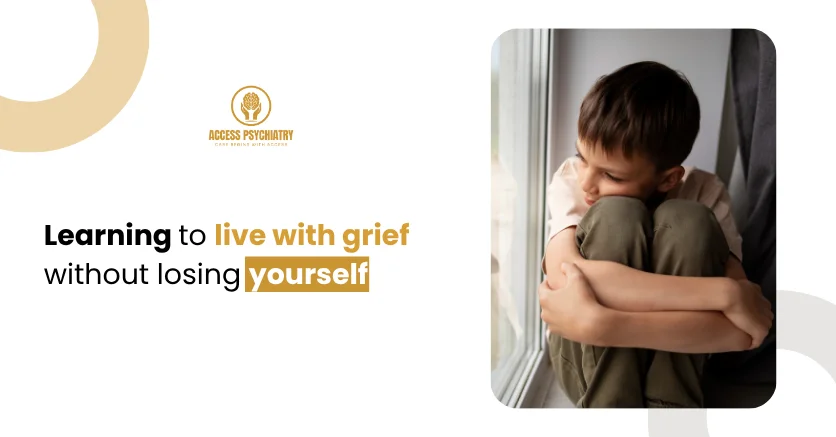
Some losses change more than our circumstances. They change the way the world feels.
When someone deeply important to us dies, life may continue around us as though nothing has happened. Morning still comes. People still go to work. Phones still ring. Conversations continue. Yet inside, something may feel profoundly different.
A familiar voice is missing. A chair is empty. A message will never come again. A person who occupied a meaningful place in your life is suddenly absent, and your heart is left trying to understand a reality it did not choose.
This is grief.
And sometimes, grief is not simply sadness. It is love trying to find its place after the person we loved is no longer physically here.
Grief Does Not Follow a Straight Line
One of the most important things to understand about grief is that there is no single “correct” way to experience it.
You may feel devastated one day and surprisingly peaceful the next. You may laugh at something and then suddenly feel guilty for laughing. You may believe you are beginning to heal, only to hear a song, smell a familiar fragrance, see a photograph, reach an anniversary, or remember an ordinary moment, and feel the loss all over again.
That does not necessarily mean you are going backward.
Grief does not reliably unfold through a fixed sequence of stages, and there is no universal amount of time in which someone should be “finished” grieving.
Healing can be uneven.
Some days you carry grief.
Other days, grief carries you.
Both can be part of mourning someone who mattered.
You Do Not Have to Forget in Order to Heal
People sometimes fear that healing means leaving their loved one behind.
It does not.
Moving forward is not the same as forgetting.
You can miss someone and still experience joy. You can honor the past while building a future. You can speak their name, treasure photographs, continue meaningful traditions, tell their stories, celebrate their life, and carry what they taught you into the person you are becoming.
Research and contemporary grief theory recognize that maintaining a meaningful connection with someone who has died can be part of adapting to loss. Remembering and honoring a loved one’s life may also provide comfort and meaning.
The relationship changes, but its meaning does not have to disappear.
Perhaps healing is not about closing the door on someone we loved.
Perhaps it is about discovering a different way to carry them with us.
Give Yourself Permission to Feel
Grief can bring contradictory emotions.
You may experience sadness, anger, disbelief, loneliness, guilt, relief, confusion, fear, numbness, or moments when you feel almost nothing.
Try not to judge yourself for what appears.
You don’t need to cry every day to prove you loved someone. There is also no deadline by which the tears should stop.
You do not have to perform strength for everyone around you.
Sometimes strength is getting out of bed.
Sometimes strength is admitting, “Today is difficult.”
Sometimes strength is allowing yourself to cry.
And sometimes strength is accepting a beautiful moment without feeling guilty that you survived long enough to experience it.
Take Care of the Body That Is Carrying Your Grief
Grief is emotional, but it can also show up physically. People may notice changes in sleep, appetite, concentration, energy, or physical tension during bereavement.
During this period, basic self-care matters.
Eat even when your appetite is reduced. Drink water. Rest when your body asks for rest. Step outside. Walk. Stretch. Sit in the sunlight. Return gradually to routines that provide structure.
Movement can be particularly meaningful, not because exercise erases grief, but because sometimes the body needs somewhere for emotional distress to go.
You do not have to rebuild your entire life today.
Take one walk.
Prepare one nourishing meal.
Make one phone call.
Complete one task.
Get through one afternoon.
Healing is often built from very small acts repeated over time.
Do Not Grieve Entirely Alone
Loss can make us withdraw, especially when we believe other people cannot possibly understand what we are experiencing.
Some people also stop talking about the person who died because they worry that friends or family are tired of hearing about the loss.
But connection matters.
Research on bereavement emphasizes the value of social support and healthy coping. Talking about the person who died, sharing memories, accepting support, and connecting with others can help people adapt after loss.
Allow trustworthy people to sit beside you, even when they cannot fix anything.
Sometimes you do not need someone with the perfect words.
You simply need someone willing to remain present when there are no words.
Be Careful with the Question, “Why?”
After a painful loss, the mind naturally searches for explanations.
Why did this happen?
Why now?
Why this person?
Why didn’t I notice something?
What if I had done something differently?
Some questions have answers. Others may never have answers that satisfy the heart.
If you find yourself trapped in guilt and endless “what ifs,” gently remember that grief often looks backward with information we possess today and asks our past self to have somehow known it then.
You can examine what happened without sentencing yourself to a lifetime of guilt.
There may eventually come a time when another question becomes equally important:
“How do I want to live now, knowing how precious life truly is?”
That question does not erase the person you lost.
It may become one way of honoring them.
Let Love Become Part of the Legacy
Loss has a painful way of teaching us what everyday life sometimes allows us to forget:
Time matters.
Presence matters.
The phone call matters.
Forgiveness matters.
Saying “I love you” while someone can still hear it matters.
The ordinary moments we barely notice today may someday become the memories we would give anything to experience one more time.
Grief can therefore become more than a reminder of death.
In time, it can also become an invitation to live more intentionally.
Love your people while they are here.
Make the visit.
Take the picture.
Have the conversation.
Celebrate the birthday.
Forgive where forgiveness is healthy.
Create memories without waiting for the perfect occasion.
And say the words that matter while there is still time to say them.
When Grief Feels Too Heavy to Carry
Grief itself is not a mental illness. Intense sadness after losing someone important can be a natural human response.
However, some people experience persistent and disabling grief that significantly interferes with everyday functioning. Prolonged grief disorder is recognized in the DSM-5-TR and can involve persistent yearning or preoccupation with the deceased, intense emotional pain, difficulty reconnecting with life, emotional numbness, loneliness, or a sense that life has lost its meaning. For adults, diagnosis requires that the death occurred at least 12 months earlier, along with additional clinical criteria and consideration of cultural, social, and religious norms.
Depression, anxiety, trauma-related symptoms, sleep problems, and other mental health concerns can also occur alongside bereavement.
When grief feels unbearable, interferes substantially with daily life, or leaves you feeling unable to move forward, professional support can help. Evidence-based psychotherapies are available for people experiencing prolonged grief.
And if grief is accompanied by thoughts of suicide or harming yourself, seek immediate crisis or emergency assistance.
There Is Still Life Beyond This Moment
If you are grieving someone special, you may not be able to imagine a future in which their absence hurts differently.
You do not have to imagine the entire future today.
You only must continue.
Healing does not mean reaching a morning when you suddenly stop missing them. It may mean reaching a morning when you remember them and discover that alongside the pain, gratitude has begun to grow.
Gratitude that you knew them.
Gratitude that you loved them.
Gratitude that, for however long life allowed, your paths crossed.
There may always be a space in your heart that belongs specifically to that person. Healing does not require filling that space with someone or something else.
It means letting the rest of your heart keep living, too.
You are allowed to laugh again.
You are allowed to make plans again.
You are allowed to love again.
You are allowed to become excited about your future.
None of those things betrays the person you lost.
Continuing to live is not leaving them behind.
Sometimes, living fully becomes one of the most meaningful ways we honor those who no longer can do so.
A Final Reflection
Grief teaches us something both painful and beautiful: we grieve deeply because we could love deeply.
So, when the memories come, let them come.
When the tears come, let them come.
When laughter unexpectedly returns, let that come too.
You do not have to choose between remembering the person you lost and continuing your own life.
There is room for both.
Carry the memories. Carry the lessons. Carry the love.
But continue walking.
Because although someone you love may no longer be physically beside you, what they gave you can continue to influence how you love, how you live, and how you show up for the people who are still here.
Some people leave our lives, but they never truly leave our story. Their presence becomes memory, their lessons become part of our character, and their love becomes something we carry forward.
Dr. M. Safari, DNP
Founder, Access Psychiatry LLC